Sunday, August 4, 2013

Around Kenya


For the last week, I have been traveling around a little.   Spent 4 days on a safari organized by NVS - the volunteer organization I am working with here.  The arrange an inexpensive trip with 3 days in the Masai Mara National Game Reserve and 1 at Lake Nakuru National Park.  It exceeded all my expectations.  I saw all of the big 5 animals - buffalo, rhino, leopard, lion and elephant - and tons more!  Here are a few of my pictures. (More to come when I get faster internet) The lions on the left were fighting over a female.  We saw this in our first 30 minutes of our first game drive in the Masai Mara.  I was also surprised at the number of young we saw - lion cubs, elephant, giraffe, monkeys, hippos, rhinos.


After the safari, I went down to the coast and spent a few days in Diani Beach, south of Mombasa with a few other volunteers.  The weather was warmer here and the water beautiful!  The people are more relaxed here and the pace much slower, than the hustle and bustle of the capital city of Nairobi.  We enjoyed a few days just relaxing on the beach.  I honed my bargaining skills, while negotiating for rides on my new favorite mode of transportation, the picky-picky (motorbike).  I wouldn't pay more than 20 Ksh for 1 km - which works out to be about 20 cents US.


For the last two days I have been in Zanzibar, but I miss the sweet faces of the Children's Hope Home and have decided to head back there tomorrow, cutting my travels short to spend my last week with the children who have captured my heart.  They are hard to resist.


Friday, July 26, 2013

Breaking the Law


"Is Duncan up yet?" asked Tobias.  "I don't know." was the reply from several sleepy volunteers. "Ah ha," Tobias responds in his quiet thoughtful way.  This young 19 yr German has emerged as one of the leaders of the 14 volunteers residing here at Lucy and Duncan's house.  He has been up since 4 am helping some of the older boys from the orphanage make chai tea.

It is 5 am now and we head off to the city center in
Nairobi to pass out butter and jam sandwiches and tea to the people sleeping on the streets. We pile into the mini van, Peter, informs me in a matter of fact way that we are going to the place where he used to sleep.  He is in his early twenties now, but he lived on the streets for 1 year and 3 months when he was 12 yrs, until he met a friend who told him about the Gathiga Orphanage.  He is one of the success
stories, a well spoken educated young man with a talent for painting.  He came with us today to show the children currently living on the streets the possibility of their future.

As we head down the bumpy road, with only 9 people in the mini van this morning -- quite comfortable, compared to the 12 or more we usually cram in -- Tobias tells me about a few of the conversations he has had with the children he met while street feeding.  Once they told him of another child who was drunk and fell into the river and drowned. Another time they were talking about a man who was lying under the bridge very close to dying.  Tobias was in Nairobi one afternoon and ran into one of these children he met during an early morning street feeding. He had a conversation with the boy and a police officer noticed and later beat the child with a metal pipe, just for speaking with Tobias.

We have to head out early, because giving food to anyone living on the streets is illegal.  As we arrive in the city center, we cruise around to the usual sleeping spots, waking up the people and inform them of our meeting spot.  Tobias, Peter and a few others jump out to help.  It doesn't take long.  For the last 3 months, with the help and funds from the volunteers, they have been doing this every 1-2 weeks.  Previously, Duncan, was only able to come once every couple of months.

Upon arrival in the alley, we have a crowd around the van.  We jump out and James hands me a tea pot.  For the next 10-20 minutes all I see are cups and discarded water and soda bottles that I carefully fill with the hot chai tea.  I try and fill the contains held by the smallest hands first.  Two patient little boys who are not taller than my waist are the first faces I see.  They are at eye level with my teapot.  I go out of my way to refill their bottles.  Their mother's face has no expression, however her eyes show gratitude.  The desire seems endless, however our supply of 3 large 5 gallon containers eventually runs out.  When I look around, I ask my fellow volunteers, Timmy and Cindy, if we have finished passing out the sandwiches.  They confirm that all are gone, but I don't see anyone eating.  They have finished already. The previous evening we had an assembly line making double-decker sandwiches out of 10-15 loaves of bread. The crowd surrounding us this morning, has devoured them so quickly, indicative of the need.

After our supplies are depleted we spend some time visiting.  I speak with several boys who are around the ages of 12-14.  Almost all have small containers of glue, shoved up their sleeves or in their hands.  They habitually sniff it to help them forget their situation.  The aroma of alcohol is everywhere.  All the children are boys, I don't see any young girls.  I am not sure why.  Angelina a woman in her twenties puts her arm around me for a photo that Duncan is taking.  She then gives me a hug and tells me that she has two children who reside at Gathiga orphanage and to tell them that Mommy says hello.  She says she has 7 children in total.  The smallest is with her, he is 19 months.  She also reeks of alcohol.  I promise that I will give her children the message.

As the street light turns off and the sun begins to rise, we get back into the van to head home.  A few of the boys accompany us around the corner.  One even jumps onto the back of a pickup truck hanging on precariously, waving and smiling until the vehicles part ways.  There is an audible sigh of relief as we see him jump off safely.

The van is quieter on the way home as we all contemplate our experience.  Peter breaks the silence, describing the gap between the rich and the poor in Kenya, as we pass through a wealthy area.  There is no middle class here.

I think this is the first time I have broken the law in a foreign country and I would do it again in a heartbeat.      

Tuesday, July 23, 2013

Future Inventors

The children here are so creative.  They make toys out of anything they can find.  Last week, Cindy, a fellow volunteer played with a 5 year old and a button for over an hour.  Many of the children
make soccer balls out of plastic bags all balled up and then wrapping it with twine to hold it all together.   This little boy (right) explained the process to me yesterday.   Talk about recycling.

Other "toys" I have seen were a lid of a paint can, used as a ball to play soccer.  A deflated beach ball becomes a super cool hat. Moses, 3 yrs, and I played with a small plastic container with a lid yesterday.  We played catch, pretend, soccer and a few other things.  Kennedy, 12yrs, was using an old spike with some metal around it to fashion a lock.  Sheila loves her doll,which she repaired with some yarn.  I have seen several children with a tire or plastic wheel that they push with a stick on my afternoon walks home from the orphanage. And any deflated ball is still perfect for soccer, probably the most popular activity behind jump rope.

This is the type of creativity and out of the box thinking is what we are always striving for in the western world.  This is what it will take to solve some of our most complex problems.  I find it inspiring.  I am really glad that these children have found their way to an orphanage that is helping them with school fees and giving them a safe environment to grow up.  They are our future inventors.  The world needs them.

Many others are not so lucky.  There are so many children living in the streets struggling to survive.  The children at the orphanage still have many issues and sometimes there is not enough food, however they are miles ahead of the street children.

Saturday, July 20, 2013

It's All About Location


We turned off the main road and entered a bumpy land with mounds of garbage on either side.  In less than a kilometer from the main road we arrived at the garbage slum.  The first thing that hits you is the smell.  This is no place to visit, let alone live here.

But that is exactly what is happening here.  About 150 families, approximately 800 people, live here in the garbage slum near Nakuru, Kenya.  The first residents arrived in the 80s when there was a war with another tribe and they were displaced from their land and had nowhere to go so they build some tents in the garbage dump.  Over the years they have been chased off the land by the local government and they move to the side of the road, but they always move back because there is nowhere else for them to live.  Many of current families have lived there since the early nineties.  So many children have been born and grew up knowing no other life.  They survive by picking through the newly dumped garbage, looking for anything of value.  Some volunteers have started helping the woman create goods that the can sell to the other volunteers that come to see the slums on the outreach program.  One thing they sell is purses made out of plastic bags.   Their  ingenuity is inspiring.

We were invited into the house of the first slum resident.  She lives there with several of her 13 children and grandchildren.  

As with the IDP camp, we distributed bags of Ugali and our personal donations of soap, candles, matches, toothbrushes, toothpaste and sweets.  Chaos ensued, when the donations appeared.  If possible to believe these slum residents were even more desperate than the IDP camp residents.  

A New Life

In 2007 Kenya held elections, that resulted in a dispute.  The election resulted in the current leader retaining power, but winning by only 50,000 votes.  Many suspected corruption in the election process and were unhappy with the current government, which resulted in a conflict that lead to violence.  Supporters of the opposition part took to the streets with machetes, hammers, anything they could get their hands on and committed acts of violence against supporters of the current president.  Men were beat and killed, women gang raped, families were burned while locked in their houses, even those who took refuge in the churches were not spared, as churches were burned as well with the people inside.  Many of those affected where middle class citizen, teachers, business owners an d professionals.  The violence resulted in 1333 people killed and hundreds of thousands people were displaced.  These are the people living in the Internal Displacement Camps (IDP)

The camp we visited originally had 158 families, now 50 are left.  They are living in tents provided by the government that were made to use for 6 months.  However this has been their home for  5 years and there is no opportunity to change this situation in the near future.  The government has helped some people but the families left in the camps are not on the government’s list of post election violence victims, so there is no plan to help them.  Several organizations have made pleas to the government on behalf of these people.  They promise many things, but do not follow through.  The land the camp is on is owned by a local man who is allowing them to stay there, however he has given them notice that they have to leave.  He may come at any point and remove them from his property.  There is also the danger of flash flood at the camp’s location and in the past all of their belongings have been washed away.

The first person we met upon arrival is Grace.  She appears to be around 60 years old and invited us into a home of one of the residents.  She explained that she is the chairperson, the leader of the camp.  She   organizes the camp life, handles donations and takes care of the sick.  She appears to be a very competent and respected leader.

Next we went to Ester’s house.  Ester is 70 years old.  She has 13 children, currently 2 of her grown children are living with her at the camp. She works at the quarry breaking stones into smaller stones.  She gets paid1000 ksh when she fills a truck that contains 7 tons of stones.  This task takes her a month to complete.  When you convert 1000 Ksh to dollars it equals approximately $12.  $12 for a month’s worth of back breaking work.  It works out to be 40 cents per day.  

Finally we stopped at the school.  This IDP camp has a two room school house for the children ages 3-6.  In the babies class there are 50 children and one teacher.  Another teacher handles the middle and top level classes. I estimate about 40 children were in this classroom.  Both teachers are residents of the camp. We helped serve lunch, which consisted of a mug of porridge and since we were there today, the children also got 3 biscuit crackers.  

People in the camp rely on volunteers and well wishers to help them.  I went on an outreach program and paid a fee of $130.  Part of this fee went towards food for the people living in the camp.  Ugali is ground up corn, we separated into quart size sandwich bags and distributed these to the members of the camp.  Grace had it organized and was calling the names of the residents one at a time, so that all members received their  fair share according to family size.  

After distributing the food, the other volunteers and I passed out the additional supplies we purchased in the grocery store before we came.  I purchased soap, candles, matches, toothbrushes, toothpaste and some sweets for the children.   I spent a total of 1300 Ksh – about $16.  I gave away half my supplies at the IDP Camp, the rest I will use at the garbage slum.  This distribution was not so orderly, we were each mobbed by adults and children alike to get much needed supplies.  I tried to be fair and pass as much of it as possible to the adults, however everyone was desperately grabbing for anything.  I cannot imagine being so desperate for such small necessities.  I didn’t grow up with much money, but I always had a roof over my head, light to see, an opportunity to go to school and food to eat.  This is not the case in the IDP camp in Kenya.  It is especially sad here, since before the 2007 election violence these families had a middle class life.  You never know what turns life are going to take.  Take the time today to be grateful for what you have and you appreciate your current situation.

If you would like more information about this situation, there is a dvd that explains more about the 2007 election violence called Kenya’s Darkest Hour.

A Story of Hope

After traveling 30 minutes down a bumpy red dirt road with ruts and pot holes ranging from 6 inches to 2 feet deep, we made a sharp right turn and arrived at a bright blue gate.  A few small boys opened the gate after a friendly beep and stood ready to close them after we passed.  Once inside, the children flocked to the white van and even before we could get out, they crowded the door and began introducing themselves and shaking our hands.  The handshakes quickly became hugs and children linked arms with us and held our hands as we embarked on our tour.  We had arrived to the first of two orphanages that comprised the Hope Home orphanages, Gathiga, home to 73 children with smiling faces and beautiful hearts.

Gathiga, actually began by accident.  Back in the mid ninties, Lucy, a Christian woman began to feel that she needed to do something for the poor in her country, so she began to pray for a solution to this need she felt.  She prayed for a while and then she began to feel fear, afraid that she might not be able to handle the answer she was given.  She decided to stop praying about this issue and go about her usually business.  One day while traveling by matatu to visit her mother, she had to pass to the Nairobi city center.  On this journey she could see the poor and slums around her and she began to cry.  She tried to hold the tears back but could not keep her feelings inside.  Finally feeling overwhelmed, she got off the matatu and  began to talk to the street children in the slums.  That first day she purchased some food and shared a meal with the children.  Then she promised them she would come back next week.

For several weeks, Lucy traveled to the slums to meet with the children, talking with them and often sharing a meal.  One day she decided to invite them to her house, so they could see how she lived.  They were very curious and excited to come, so the next week using the money Lucy provided for transportation the boys arrived at her house.  They had a wonderful afternoon sharing a meal and meeting Lucy’s family.  However when it came time to leave, the boys refused to go.  They pleaded with Lucy that they did not need much space and they could sleep on the floor.  She argued with them, stating that this was not the deal they made.   The agreement was for the day, not forever.  But the boys were adamant that they were not leaving.   Lucy spoke with her husband, Duncan, who reminded her that she started something and she had to finish it.  So they stayed, and Gathiga Hope Home was born.

In the early days, Lucy and Duncan’s home served as the orphanage, but now they have two separate locations, Gathiga Hope Home with 73 children and Ebenzer  Hope Home with 30 children.  Most of the children have come from the streets and all the orphans at Ebenzer have a connection with HIV, either they have it or some relative has had it.  I will be working with both during my stay in Kenya.  They already have my heart.

Thursday, November 25, 2010

Thankful


"She not only saw the light at the end of the tunnel, she became that light for others."  -excerpt from Gabi's journal, but quite appropriate for all the children at the Tutova pediatric recovery clinic.

I am so thankful for the children of Tutova and the opportunity to have met them.  Their courage, laughter and smiles have touched my heart and taken up permament residence there.  I am hoping to return someday soon.  Until then I will support them in any way I can.  One of the biggest needs its bottle liners.  With 21 chldren at the clinic they go through approximately 120 a day and they do not sell them in Europe.  Clothing, shoes, socks, jackets, hats and toys are also always needed.  I am particularly looking for a mobile - they only had three that we saw and sometimes there are more than three babies stuck in there rooms all day because they are in isolation.  I will be putting together a package to send over.

Another large need is the role I helpful fulfill for the last couple of weeks - engage the kids with play time, games, hugs, basically show them the love they’re missing from their parents being absent.  Global Volunteers has trips just about every three weeks all year long.  If you are able and inclined, please check out their website:  http://www.globalvolunteers.org/. In the last couple of years they have seen a significant decrease in the number of volunteers, groups used to be around 15-20 (which allowed for one on one interaction with the children) and now are around 6-7, sometimes only 1 or 2 people. 

Please contact me with questions if you are interested in helping:  sabrina_shaner@hotmail.com 

Happy Thanksgiving!

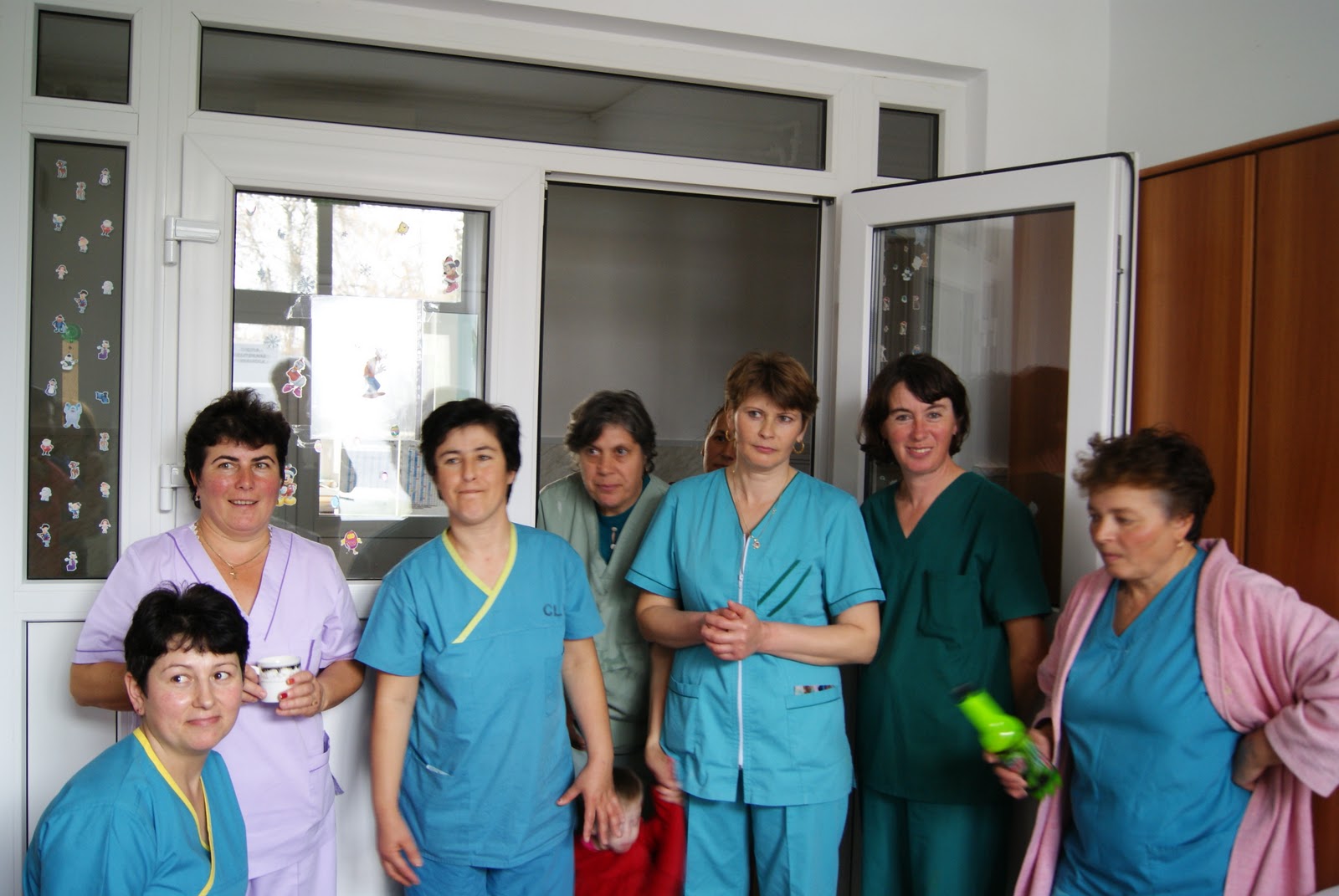
The dedicated staff

Monday, November 22, 2010

Bucharest and the Painted Monasteries

After hugs (and a few tears) for all the children, aides and our volunteers, Sonya and I headed north to Suceava and the painted monasteries.  Two trains and about 5 hours later, Monica, our helpful hostel owner, picked us up at the train station and we settled in after a long emotional day.  After a good nights rest, we set off with Monica as our guide to the monasteries.  We visited four of these amazing places - Humor (1530), VoroneÅ£ (1488), MoldoviÅ£a (1532), SuceviÅ£a (1585) monasteries and the Marginea Black Pottery Center.  Black pottery is unique to this area in Romania and created by using very high temperatures in the kiln. (I think - I got a lot of information that day!)  On our way Monica filled us in on the monasteries, Romania culture and pointed out several stork nests. All the monasteries are run by the nuns, many of whom Monica knows personally.  In fact we stopped about one of the nun's mother's houses to pick up some things she wanted to send to her daugher.  The frescoes cover the churches completely inside and out.  The plaster is only 1cm thick and it has never been repainted, only cleaned - to remove the soot from using candles inside the church.  They are amazingly peaceful places with extraordinay beauty.  At one of the monestaries we witnessed a nun walking around the church beating on a wooden board about 6 feet long with a mallet, signaling the start of prayer and cleansing the church of evil spirits.  Upon returning to Suceava, we had a delicious dinner of Monica's homemade potatoe soup, bread, zacusca (a fantastic vegetable spread made by the nuns) and pickled green tomatoes.   Monica's knowledge and kindness really made the weekend extraordinary.  I can't say enough good things about the High Class Hostel!


A view from the front of the SuceviÅ£a monastery.  It is the largest of the four I saw.


The battle of Constantinople depicted on the MoldoviÅ£a monestary.


More frescoes on the outside of the MoldoviÅ£a  monastery.  There is so much detail in every picture.   Unfortunatelyy, no pictures were allowed of the insides. 


Sonya admiring MoldoviÅ£a.  The dedication of the monks who painted them is awe-inspiring.  Because they were painting on wet plaster they had to paint quickly and could not make any mistakes.   
My day in Bucharest was a little slower.  I have caught the cold that the childent at the clinic and some of my fellow volunteers had.  So I took it easy, but I did feel well enough to wander around old town for a bit and then took a tour of the Palace of the Parliament.  It is the second largest goverment building - the Pentagon is the first.  All the materials to build it came from Romania.  Started in 1984 and still not finished today - about 95%.

Thursday, November 18, 2010

The Miracle of Tutova

How can this little place create so much love?  It is easy to say it is because of the children.  Who could not melt looking into the big brown eyes of the twins, or gaze is awe at the miracle of Maria Cleopatra?  Or be won over by the laughter of Christie, or the smiles of Andrea and Celine? Or lose their hearts Petra, or Daniella, or Marius, or Ion or Alex, each with his or her own special charm. Or be delighted after spending 5 seconds with tiny Aleena who is nature’s perfect mimic who mirror’s back to each of us our own individual tricks or talents?  And of course there are the infants so small and vulnerable and dependent.  Each is indeed a miracle and a joy but Tutova is much more than these beautiful children.

Tutova is a very special place unto itself.  The rural setting and all the hard work that goes into the upkeep of the grounds and buildings makes the clinic and hospital a lovely and serene place. The long tree lined drive makes a perfect place to take the children to watch the outside world as it passes on its daily tasks.  The gardens that even in late autumn hold the remnants of beautiful flowers and bountiful orchards and gardens. And yet the miracle goes beyond even the place.

There is a spirit here that unites people from all over the world.  A feeling of hope and promise that if we can join together to help the smallest among us perhaps we can bring love and laughter back into places where they have become far too rare.

The nurses and aids that work at the clinic clearly love each of the children and each other.  They consistently open their “home” to new people, people who often can’t even speak their language.  People who have new ideas, who don’t know or understand the routines of the clinic, and who often create extra work even when making an honest effort to help.  But through all these events the aids and nurses remain patient and, as they do with the children try to teach the volunteers how to provide what is needed as well all allow for the special gifts each volunteer brings from her or his experience.  These are not only skilled and caring people but also individuals capable of providing great kindness and support to those from beyond their home.

And there is one more thing that adds to the magic of Tutova and that the is the dedication and enthusiasm of the team leaders, Mihaela and Don. No matter what the situation or circumstance they are available to offer support and if necessary comfort whenever it is needed to any of the workers or volunteers.  They know and love each child at the clinic as if he or she were their own.  What must it be like to constantly see a child you have grown to love leave for a future that is perhaps uncertain? And yet they always are able to open their hearts and arms to the new children that come for the care that this lovely little place can provide.

It may be difficult to compare little Tutova to the grandeur or romance of Rome or Paris, Rio or Sydney but this small place will leave a mark on your soul more rich and meaningful than many far better known locations ever can.  That is the miracle of Tutova.

 
           - Alana Poage (a fellow volunteer who eloquently described my thoughts on this magical place.)                  

PS. Today is my last day in Tutova.  I will spend the morning with the kids and then head north this afternoon to the painted monestaries.
.                                  

Tutova babies

I only get in to see the babies once or twice a day, since the toddlers keep me quite busy, but they are just so darn cute, that I had to post a few photos.


Roxanna - one of the twins with the georgeously long eye-lashes. She and her sister were brought in for malnutrition and might be going home to their parents soon. 


Andrea, Roxanna's twin sister.  I can't tell them apart.  They are equally adorable!


Ionute. He has some issues with brain density and can't control his temperature because of his hyper thyroidism.  Mel has made quite a connection with this sweet boy.


Nicoletta has a beautiful smile and is such a sweet baby - smiling all the time.  She was brought to the clinic for malnutrition.  She is around 12 months and isn't sitting up or walking yet.


Andrada is the youngest at the clinic at around 3 months old.  She has a hemangioma on her back and they also think she might have spina bifidia. She was sent to Bucharest yesterday for an evaluation.  She is really alert and responds well to Jody.
Daria is a little jumping bean.  She falls asleep in the jumper, wakes briefly jumps some more and falls back to sleep.  She has a cleft palate and has had two surgeries and with one left to go.  This condition has caused some malnutrition, however she is bouncing back fast!
Christi Daniel will be four next week.  He loves to swing and will latch onto your arm and swing like a koala bear (According to Mel - a native of Sydney).  He has down syndrome and is on the verge of taking his first steps, if you can get him to stop swinging!
Maria Cleaopatra is the clinic's miracle baby.  She has hydrocelphalus and was sent here last summer with the expectation that would pass away within a few months.  But she proved them all wrong and continues to brighen the hearts of all who meet her.  Medically they cannot provide an explaniation.  Her laugh provides a glimpse of her beautiful soul.

*Not pictured are Raul who is in isolation with a rare condition called Epidermolysis bullosa or Butterfly disease.  It causes his skin to shed and gives him painful blisters.  And Paola, who took her first steps last week after working with Dan for 1 1/2 years.  She has autism and some mental disabilities.   

Wednesday, November 17, 2010

The final four

The final four children in the mobile room are:  Celine, Alexandra, Marius and Ion.  There is also a whole other crew of babies in the non mobile room.  Mel, Jody and Sonja are holding down the fort there, but I try and stop in for a visit when I can. 
Alexandra is 8 yrs - the oldest child at the clinic.  Generally they do not have children who are older than 3 or 4, so she is a unique case.  She has brittle bone disease and dwarfism.  She isn't verbal but is very observant and knows what she wants.  She loves to be outside and will lead you to her stroller to communicate her desire to go outside. She is a quiet child that loves books and magazines.  She has a fantastic giggle that makes everyone in the room smile.  You can get it going with a trip down the slide or a tickle under her chin.

Celine is an extremely bright little girl.  She picks new words all time, both Romanian and English.  She will probably be able to help the staff with translations in a few years!  She is the only child in the mobile room who isn't walking, but gets around quite well scooting on her knews.  She has clubbed feet and has had a couple of surgeries to fix them, but they didn't go well. She also has a lump on the back of her spine that may be causing some issues with walking.  Unfortunetly her doctor will not prescribe her braces, but they are going to send her to Bucharest for a second oppinion.  She has an incredible strong upper body and pulls her self up on the wall in order to get ahold of the doornob to get out of the playroom.  I think with or with out the braces, this smarty will figure out a way to walk.  She is quite determined and hates to be left out.


Ion is all boy.  He loves la machina (any car, truck, etc) and will climb anything - even you.  It is hard to get a good picture of him because he is constantly moving.  His favorite word is "Pa" or "Bye".  He is especially skilled at escaping the playroom and waves to everyone on his way ouat.  He had to have surgery on his heart and has some respiratory issues, but that doesn't stop this rambunctious little guy.  He will tackle you from behind and then win you over with a smile.

This blue-eyed cutie is Marius.  Although he appears quite indpendent and agresssive at first, he is actually a sweetheart.  Show him a little attention and he will return it 10 fold and it will melt your heart. The first couple of days my only interaction with him was to say "Marius, No!", when he pulled the hair of one of the other children - an action he found quite funny.  But I noticed one day that he was handing me the push popper and I would play with it a little he would watch me contently from across the room.  He didn't pull anyone's hair that afternoon.  Ever since then he comes over to me each morning for a big hug and often sits quietly on my lap.  I also discoved that he loves to be tickled under his chin.  His laugh is one of the best.  He has autism and has some heart issues, but they just found out that he will not need to have an operation - definitely good news!  He doesn't interact with the other children, so I think the adult interaction is extra special for him.  I will miss this sweet boy.  

Tuesday, November 16, 2010

Todder Romanian

I speak toddler Romanian.  Talking to nurses and aides at the hospital is a bit more difficult.  It's is more charades than talking.  They are really good and we have managed to have some brief exchanges of information.  But my toddler Romanian is solid.  It is a short list, but very effective.  Buna - Hello; Buna Dimineata - Good Morning; Buna Zuia - Good Afternoon;  Buna Seara - Good Evening;  Bine - Good; Da - Yes; Nu - No;  No Lovi - Don't hit;  Mui, mui - Nice, nice (spoken often after No Lovi),  Te Rogue - please; Bravo - Good Boy/Girl (used all the time for everything);  frumos - beautiful;  Sos - Up;  Jos - Down; Al la mesa - to the table (for breakfast, lunch and dinner); Hai eeche - Come here; Hum, hum - Dog (similar to woff, woff); Calu - Horse; La Machina - machine (used for cars, trucks, etc); Pa - Bye;  La Revedere - Bye (formal)  I can also count from 1-10, which I learned from the preschool teacher - repeating along with the children.  I also picked up the animals and up/down when the aides were teaching the children.  I try to be a good student!  There is also the some words that transend language - Uh oh and ca-ca (for anything dirty).  The todder's personalities are really starting to shine through.  
This sweetheart is Gabriela.  In this picture she is practicing standing on her feet with her weight on the entire foot and is quite proud of herself.  When we arrived last week she would only stand on her toes.  Mel, who is an occupational therapist, has been working with her and she is now walking on her whole foot and is only holding on to one hand.  Mel is determined to have her walking by the end of the week.  Gabi has a twin sister, Miheala, who recently retuned home to their parents.  Miheala is a thriving little girl who overcame her mal nutrition and is on par developmentally.  Gabi, however is a little behind.  She also has an issue with her eyes, but is going to the doctor this week to see if it can be repaired by surgery.  As a result of her eyes and possibly a mild case of autism, she explores her world ever so gently by smelling and feeling objects with her lips.  She has a wonderfully sweet personality and loves to cuddle with her head on your shoulder.  She has a fantastic appetite and has the record for the fastest bottle in the west.

This dancing queen is Daniela.  She is fiercely independent and holds her own with the other children in the toddler room who are all bigger than her (except for Alina).  She has been diagnosed with Turner's syndrome, which means she will always be small and probably won't be able to have children.  She is a generally happy girl and has staked  a claim on my lap.  She will run from across the room to defend her territory. 

A few updates - I got Alina on the scale and she weights 14 lbs, a tiny size for a 3 year old, but Jane says that she was only 11 lbs when she was here in July.  And Anna Maria is now out of isolation and allowed  in the babies playroom.  Hopefully the additional stimulation will continue to help her development.

Saturday, November 13, 2010

Transylvania

We have the weekend as free time, so Mel, Jody, Sonya, Alaina and I have come to Transylvania.  This morning we were in Brasov visiting the Black Church and town square and spent the afternoon at Bran Castle.  Outside Bran Castle was an open air market that was enjoyed by all, especially Jody.  We enjoyed our free time immensely, but find our conversation keeps returning to the children at the clinic.  They have worked there way into our hearts and are constantly in our thoughts.  Upon arriving at our hotel this evening we were excited to see a children's store next door and Sonya has finally found a mobile for Anna Maria.  (There are only two at the clinic that we know of and lots of babies.)  Below are some pictures from todays adventure.

On our way to Transylvania we stopped at a roadside stand selling this delicious sweet bread the is roasted over hot coals and covered in cinnamon and sugar.  Jod and Mel are watching as he makes us a fresh batch.


Sonya took and early morning stroll in Brasov and discovered this beautiful small wooden church.  These are some of the windows in the church.
The buildings in Brasov are really pretty. The architecture here wasn't affected as much as other cities during the communist era.  It also has more of a German influence.  This is actually the post office where we stopped to pick up some post card stamps.


Jody and Sonya enjoying Transylvania.  The large church in the background is Black Church.


Black Church. It was renamed in the 1600 after a fire destroyed much of the town of Brasov and caused damage to the church.


Brasov town square.   The weather was fantastic. It was a little chilly, but there was plenty of sunshine.  


A church that Mel and I discovered just off the
Brasov town square.  They were having a baptisim ceremony for several children.


Bran Castle, also as Dracula's castle.  Although there is little evidence that Vlad the Implaler lived or even stayed in this castle. 
 We were sad that Cindy, one of the other volunteers couldn't join us in Transylvania.  She could only stay one week in Romania and was on her way home, so we drew a picture of her to take with us. This is Cindy entering Bran Castle. 


The view of the town of Bran from the castle.